Which Materials To Choose For A Durable And Easy-to-Maintain Garden Dining Room?
Furnishing a garden dining room requires careful thought, well beyond simply choosing an aesthetic option. Between climatic constraints, frequency of use, and ease of maintenance, each material has its own characteristics. From the very first stages of your project, selecting an set of wooden garden table and chairs helps to organise the space harmoniously while benefiting from a material recognised for its durability. To make an informed choice, it is essential to understand the technical features of each option and their impact on daily use.
Understanding the constraints of outdoor furniture
The garden table and chairs are subject to much more demanding conditions than indoor furniture. Climate variations play a significant role in their ageing. UV rays, for example, can alter colours and weaken certain materials. Prolonged exposure often results in discolouration, especially on low-quality plastics or untreated wood. Humidity, on the other hand, encourages the appearance of moulds, swelling of the wood, or corrosion of certain metals.
Stability is also a key criterion. A standard garden table should have a sufficiently thick top, generally between 2.5 and 5 cm, to withstand temperature variations without warping. The base must ensure good ground anchoring, especially in windy areas.
Finally, usage directly influences the choice. A large family will favour a table of 180 to 240 cm, while an urban balcony will require a compact model of 70 to 120 cm.
Wood: Authenticity and Managed Sustainability
Wood remains an essential choice for an elegant and warm garden dining room. It provides an incomparable natural feeling and integrates just as well into a landscaped garden as on a contemporary terrace.
The fuels to prioritise
Not all types of wood possess the same resistance to external assaults. Some are particularly suitable:
- Teck : high density (around 650 to 750 kg/m³), high natural oil content, excellent resistance to moisture and insects
- Acacia : hardwood (around 700 kg/m³), good longevity with autoclave treatment, slightly golden appearance
- Eucalyptus: robust and economical, requires regular protection against drying out
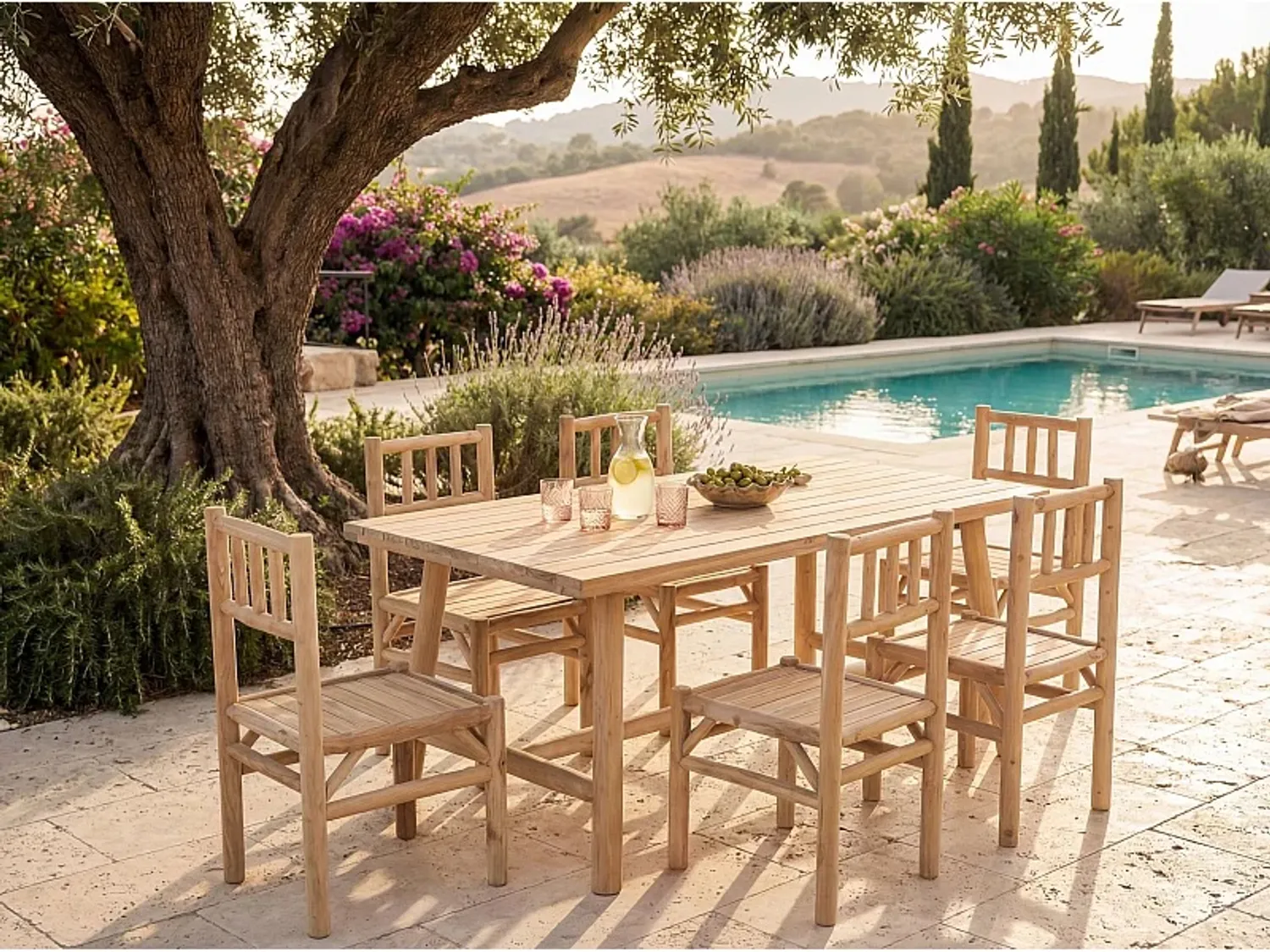
A wooden garden table made of solid teak can support heavy loads without deforming. Its stable structure and thick tabletop ensure a lifespan that can exceed two decades.
Maintenance and Aesthetic Evolution
Wood is a living material. Over time, it naturally evolves, taking on a grey-silver hue under the effect of UV. This phenomenon does not impair its mechanical performance but alters its visual appearance. To preserve its original colour, applying a protective oil is recommended once or twice a year. This treatment nourishes the fibres and limits superficial cracks.
Garden wooden chairs should be monitored at the joints. Screwed or mortise and tenon models offer better long-term durability than structures simply glued.
Aluminium: Modernity and Effortless Strength
Aluminium is established as a benchmark choice for those seeking furniture that is both lightweight and highly durable. A garden table in aluminium is not afraid of rust or bad weather, making it a particularly suitable material for demanding environments.
Technical Specifications
Unlike steel, aluminium requires no additional anti-corrosion treatment. It maintains its original appearance for many years.
Aluminium also presents several major advantages:
- Lightweight, generally between 10 and 20 kg for a 6-person table
- Natural corrosion resistance, ideal for coastal areas
- Rigid structure thanks to reinforced profiles
- Powder-coated finish providing protection against scratches and UV rays
Comfort and versatility
A garden aluminium chair can be paired with different materials to improve comfort. Textilene seats, for example, offer excellent breathability and mould to the shape of the body.
Some models feature wooden armrests or removable cushions, combining comfort and ease of maintenance. This modularity allows for creating sets suitable for various interior styles.
Plastic: Functionality and Simplicity
Plastic is often chosen for its practicality and affordable cost. A plastic garden table provides an ideal solution for everyday use without maintenance constraints.
The different available qualities
High-end models include anti-UV treatments that significantly slow down discolouration.
Not all plastics are created equal. Their durability depends on their composition:
- Injected Resin: lightweight, economical, suitable for occasional use
- Woven Resin: aesthetic look similar to rattan, better durability over time
- Reinforced Polypropylene: high resistance to shocks and UV, more rigid structure
Ease of maintenance
Plastic requires no special treatment. Cleaning with clear water or soapy water is sufficient to remove dirt. It is not afraid of humidity or stains, making it a particularly suitable choice for families.
However, it is recommended to avoid prolonged exposure to extreme temperatures, which can weaken certain plastics over the long term.
Match the materials for a balanced finish
Combining multiple materials allows for optimisation of furniture performance while enhancing its aesthetic appeal. A garden table and chair set hybrid often better meets usage requirements.
The most pertinent associations include:
- Aluminium Structure and Wooden Top to combine durability and visual warmth
- Aluminium and Textilene for a lightweight and comfortable ensemble
- Woven Resin and Cushions for a friendly and elegant atmosphere
This approach also helps to reduce maintenance constraints. For example, an aluminium deck avoids the regular treatments required for wood, while maintaining a durable structure.
Choosing the Right Seats to Complete the Set
The choice of seating is crucial for overall comfort. A garden chair should be selected carefully to match the table and the intended use.
Materials also play a key role. An aluminium chair with a textile seat will be lighter, whereas a wooden version will offer greater stability. Several elements must be considered:
- Standard Seat Height between 45 and 50 cm for compatibility with most tables
- Seat Depth between 40 and 50 cm for good support
- Presence of Armrests for prolonged meals
- Stackability or Foldability to optimise storage
Adapting the choice of materials to one's way of life
Each use involves specific constraints. The choice of material must therefore adapt to daily habits, whether it is intensive family use, occasional meals or an exposed outdoor space, in order to ensure comfort, practicality and durability.
Occasional Use
For occasional use, choose materials that are easy to handle and store. A folding table made of aluminium or plastic, around 120 cm, is perfectly suitable for four people.
Regular usage
Frequent use requires durable materials. A solid wooden garden table or a reinforced aluminium frame ensures better longevity. Extensible models, increasing from 180 to 240 cm, allow more guests to be seated.
Climate Constraints
Adapting the material to the environment helps to limit damage and reduce maintenance. The climate significantly influences durability:
- Wetlands : aluminium and plastic recommended
- Sunny regions : treated wood or powder-coated aluminium
- Seaside : aluminium preferred to prevent corrosion
Efficiently maintain your garden dining room
Proper maintenance ensures the longevity of the furniture and preserves its aesthetic appearance, by limiting wear caused by weather, UV rays, and dirt, while maintaining comfort and material strength throughout the seasons.
Adopting simple and regular maintenance gestures allows you to sustainably preserve your outdoor furniture while making it easier to use on a daily basis :
- Frequent Cleaning with products suitable for each material
- Application of protective oil on the wood once or twice a year
- Use of waterproof covers during the winter period
- Storing cushions in a dry area
Beyond the choice of materials, the overall layout plays a key role in the success of a garden dining room. The harmony between the elements, proportions, and colours helps create a pleasant and functional space. Well-sized furniture, combined with complementary materials, transforms the garden into a true extension of the house. Durability depends not only on the material selected but also on the coherence of the overall design and the attention given to its maintenance.