
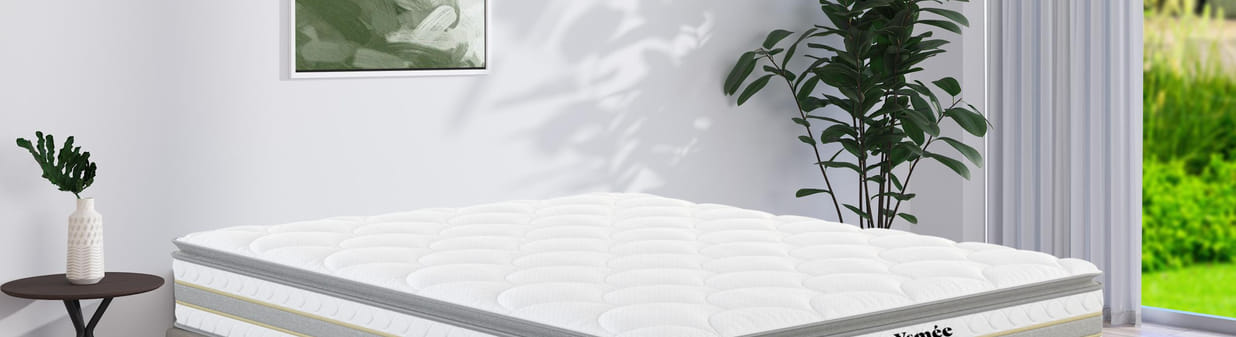
How to properly maintain your bedding: tips and tricks
Did you know that maintaining your bedding on a regular basis helps improve the quality of your sleep as well as prolong the lifespan of your mattress, bed base, mattress topper, and pillows? Otherwise, dust mites, bacteria, and gradual wear and tear can quickly set in. Vente-unique reveals its expert advice on keeping a healthy bedding setup over the long term. Protect your comfort and your health through proper management of your bed hygiene.
Why is it important to maintain your bedding?
Keeping clean bedding is important for your well-being. Regular cleaning helps prevent allergies and ensures the long-term use of your equipment.
To protect your health
Every night, your body releases sweat and various impurities. Your bed, especially your mattress and/or mattress topper, becomes the ideal refuge for dust mites, bacteria, and dust.
The proliferation of allergens inside sleep equipment such as pillows, sheets, the duvet, and the mattress is a risk to your health. It encourages the appearance of allergies through sneezing or nasal congestion, but also asthma and other respiratory problems or skin irritations.
To limit these risks, cleaning your bedding is an aspect that should not be overlooked. Maintain a healthy sleep environment and protect your health over the long term by adopting these good practices:
- Air out your bedding and your room regularly;
- Change your bed linen at least once a week;
- Vacuum and clean your mattress to eliminate all dust;
- Clean your mattress topper if you have one.
To prolong the lifespan of your bed equipment
Well-cared-for bedding lasts longer. Every night, mattresses, sheets, and pillows undergo friction and pressure from your involuntary movements during sleep. To this is added the accumulation of moisture and dust. The result? Your bed equipment gets damaged faster.
To avoid these inconveniences, adopt a few simple steps such as turning your mattress every 3 to 6 months, protecting it with a machine-washable waterproof mattress protector, or frequently washing your pillows and duvet to eliminate persistent dirt.
Good to know: A poorly maintained mattress can quickly sag, losing its comfort and its firmness. The risks? Significant back pain.
What is the maintenance frequency for each element of your bedding?
Quality sleep and durable bedding require frequent maintenance of every part of your bed.
Sheets and pillowcases
To maintain perfect hygiene, change and wash sheets and pillowcases at least once a week. If you usually sleep without pyjamas or do not take a shower before going to bed, adopt a higher washing frequency. Regularly changing bed sheets reduces the proliferation of bacteria and dust mites.
Our practical advice is to wash your bed set at the right washing temperature depending on the nature of the textile (from 30°C to 60°C), to use a gentle, hypoallergenic laundry detergent for sensitive skin, and to dry them in the open air if possible (or in a tumble dryer).
The mattress and mattress topper
Although it is less exposed, the mattress also requires periodic maintenance. For this, we advise you to vacuum it every month to remove allergens as well as dust, and to use natural cleaning products to eliminate stains, such as baking soda or white vinegar.
Our extra tip: Turn your mattress every 3 to 6 months to prevent sagging. Air out your room for ten minutes every day to clear out moisture.
To get even more comfort, you have chosen to install a mattress topper on your bed? Excellent idea! However, this sleep accessory also requires careful cleaning to remain healthy and long-lasting. Make sure to vacuum the surface of the mattress topper once a week. You can carry out a deep clean every 3 to 6 months (some are machine washable, others are not). Finally, air out the mattress topper once a month by leaving it in the open air for a few hours.
Good to know: Prefer dry cleaning for a foam or memory foam mattress topper. For a localized stain, use a damp cloth and baking soda.
Pillows and duvets
Pillows and duvets should be washed every six months depending on their composition. Opt for a machine wash at a low temperature to avoid damaging them. Ensure they are completely dry before putting them back on your bed, to prevent the growth of mold. Remember to shake and air them out very often.
Did you know? Memory foam pillows require specific maintenance, usually with a simple surface cleaning.
A few techniques and tips for effective cleaning of your bedding
Simple natural tips allow you to keep your bedding clean and comfortable. Follow the guide to eliminate stains, deodorise, and protect your sleeping setup daily.
Cleaning stains on a mattress
Various stains can quickly damage your mattress (sweat rings, urine, blood). No need to use chemicals! Natural solutions are enough to tackle them.
First, baking soda: generously sprinkle the stained area, leave it to act for 30 minutes, and finally, vacuum. With white vinegar, you just need to dilute it with warm water, apply it with a cloth, rub gently, and then let it dry.
Our tip for stubborn stains: Apply a mixture of 2 tablespoons of baking soda and 1 tablespoon of hydrogen peroxide, let it dry, then vacuum.
Deodorising and disinfecting bedding
Do you notice unpleasant odours coming from your bedding? Don't wait any longer to freshen it up! To get rid of them, rely on the effectiveness of a homemade blend using a mixture of 3 tablespoons of baking soda and 5 drops of essential oil (lavender, eucalyptus, or tea tree). Sprinkle it over the mattress, leave it to act for 30 minutes, then vacuum. A breath of fresh air will blow through your room!
Did you know? In addition to their antibacterial and anti-dust mite properties, the action of essential oils deodorises and brings a touch of freshness.
Protecting your bedding to prevent dirt and odours
To save yourself from cleaning your bedding too frequently, nothing beats proper protection. Install a mattress protector or a washable waterproof mattress cover to block stains and moisture. Make sure to air out your room every morning to limit the formation of mold, and you can also place a dehumidifier in the room if the humidity level is too high.
When should you change your bedding?
Even with regular and meticulous maintenance, bedding has a limited lifespan. Mattress, bed base, bed linen: when should you think about replacing them? Vente-unique explains it all!
The lifespan of different sleep equipment
Each piece of sleep equipment has a specific lifespan. To guarantee a restorative sleep and good hygiene, certain timeframes must be respected. Let's take a look at the recommended replacement intervals:
- Mattress: Change it every 7 to 10 years maximum depending on the quality and frequency of use;
- Mattress topper: Consider buying a new one every 3 to 5 years if it is used daily;
- Pillow: Replace it every 1 to 2 years (loss of firmness and accumulation of bacteria);
- Duvent: Renew it every 5 to 10 years depending on the material (synthetic or natural). Remember to wash it often.
Signs of aging bedding
Your bedding is at the end of its life if you notice a loss of comfort characterized by a mattress that sags or has lumps, pillows that no longer support your head properly, or a duvet that no longer retains heat. Persistent and unpleasant odours can also be an indicator if they linger despite thorough washing — they prove the presence of bacteria. You might also be alerted by too much mold.
Finally, frequently waking up with diffuse or localized pain points to old bedding. With aches or tensions becoming more pronounced in the back, shoulders, or neck, one might wonder if the bedding is still fulfilling its support role.
Thus, unrefreshing sleep, back or joint pain, stiffness upon waking, stress, and mattress deformation are all signs of aging bedding. It is then time to change it!
What budget should you plan to replace your bedding?
As you might guess, replacing a mattress and bed base set often represents a major investment, but one that is indispensable for your health and sleep quality. Depending on the sleep elements, we provide an overview of the costs to anticipate:
- Mattress: Prices vary between €200 and €1,500 (£174 and £1,305) depending on the technology used (foam, springs, latex) and manufacturing quality. Perhaps it is more economical to invest in a pricier model that has a longer lifespan?
- Bed base: Essential to guarantee good support, prices differ according to the composition (fixed slatted bed base between €100 and €400 (£87 and £348), upholstered sprung base / divan base between €200 and €600 (£174 and £522));
- Pillow: Prices vary according to materials between €20 and €100 (£17 and £87) (memory foam, feathers, synthetic);
- Duvet: Prices oscillate between €50 and €300 (£44 and £261) depending on the filling and the season.
You now have all the cards in hand to properly maintain your bedding and keep it for as long as possible. Now, you are certainly wondering if you need to replace it to improve your sleep and quality of life? Test and approve your future bedding from a wide choice of models! And sleep soundly!
