
How to Keep Your Spa Water Crystal Clear All Year Round?
Having a spa at home transforms everyday life into a truly relaxing break. However, this experience can quickly be spoiled by cloudy water, unpleasant smells or an uncomfortable sensation on the skin. Keeping the water clear and healthy requires a methodical approach, based on rigorous hot tub maintenance and a good understanding of the water parameters. Whether you use a classic model, an inflatable one or a spa, every detail matters to ensure optimum quality all year round.
Understanding the causes of cloudy spa water
Crystal-clear water is never a matter of chance. It results from a precise balance between filtration, disinfection and chemical parameters. As soon as one of these elements becomes unbalanced, the water turns cloudy.
The relatively small volume of a hot tub (generally between 800 and 1,500 litres) leads to a rapid concentration of impurities. Each bathing session introduces organic residues: sweat, sebum, cosmetics and even residual detergent from swimsuits. For example, two users for 20 minutes may be enough to throw the water out of balance if no treatment is adjusted.
External particles also play a role: pollen in spring, leaves in autumn, and dust in summer. These microscopic elements accumulate and sometimes escape filtration.
Another key factor concerns spa water treatment. An imbalanced pH (below 7.2 or above 7.6) greatly reduces the effectiveness of disinfectants. Water that is too alkaline encourages limescale deposits, while water that is too acidic can irritate the skin and damage the equipment.
Finally, the high temperature (often 37 °C to 40 °C) creates an ideal environment for bacteria. Without proper disinfection of your spa, their proliferation becomes rapid and visible.
The Fundamentals of Effective Hot Tub Maintenance
Keeping water healthy above all comes down to regularity. Good hot tub maintenance does not necessarily require much time, but it does require consistency.
An effective routine is built around simple but essential steps:
- Check the pH using test strips or an electronic tester.
- Adjust the disinfectant level after each use.
- Clean the filters to ensure optimal circulation.
- Remove visible impurities with a suitable net.
- Always cover the hot tub after use.
A standard filter, measuring between 10 and 20 cm in height with a diameter of 8 to 15 cm, should be cleaned with clean water twice a week. Once a week, cleaning with a specific degreasing product removes invisible residues. Without this regularity, even a little-used spa can quickly develop cloudy water.
Chlorine or bromine for a hot tub: making the right choice
The choice of disinfectant directly affects water quality and user comfort. The question of chlorine or bromine for a spa depends mainly on how it is used and each person’s sensitivity.
Chlorine acts quickly and remains cost-effective. It is perfectly suitable for occasional use. However, its sensitivity to heat reduces its effectiveness in water at 38 °C, and its odour can become pronounced.
Bromine, on the other hand, stands out for its thermal stability. It retains its effectiveness even at high temperatures and in slightly unbalanced water. It is also gentler on the skin and eyes.
In a spa used several times a week, bromine provides greater consistency. For occasional use, chlorine remains a practical solution, provided the dosage is monitored carefully.
The paramount importance of filtration
Filtration is the first line of defence against cloudy water. It removes suspended particles and contributes to overall balance.
A spa must filter its water volume at least three times a day. For a 1,200-litre pool, this corresponds to approximately 6 to 8 hours of filtration per day.
To optimise this system:
- Frequent cleaning of filter cartridges.
- Regular replacement every 3 to 6 months.
- Checking the pump flow rate.
- Adjusting the filtration time according to usage.
Insufficient filtration leads to a gradual build-up of particles, making the water cloudy and less pleasant.
The Spa Ozonator: A Discreet Yet Powerful Ally
The spa ozonator is an effective technological solution for improving water quality. It injects ozone, a natural gas with powerful oxidising properties.
This system acts directly on bacteria, viruses and organic matter. It can significantly reduce the use of chemicals, sometimes by as much as 30 to 50%.
Its operation is automatic and integrates with the filtration cycles. The ozonator also improves water clarity and limits unpleasant odours.
In recent spas, it is often integrated. For older models, installation remains straightforward and represents a worthwhile investment.
Specifics of maintaining an inflatable hot tub
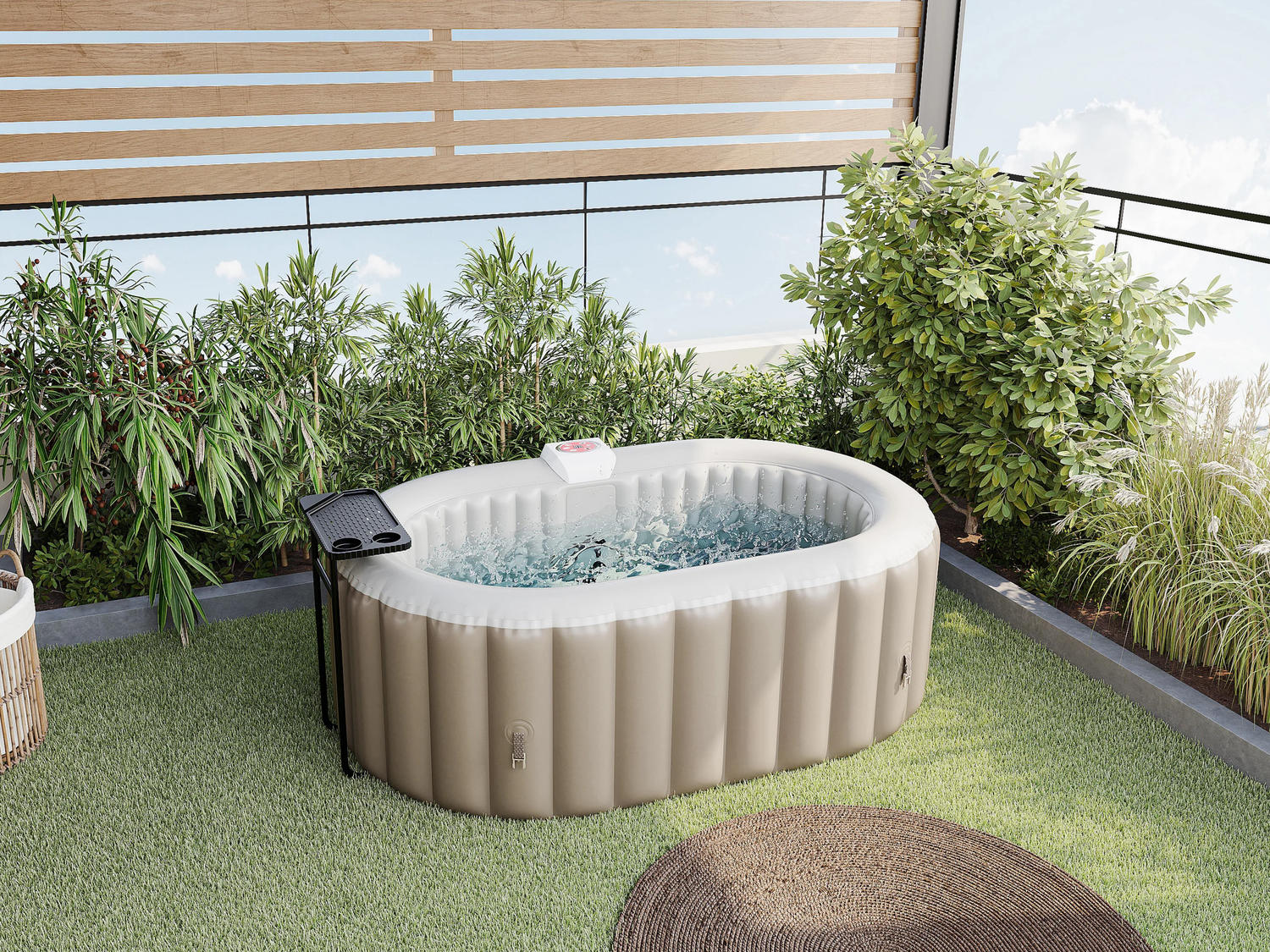
Maintaining an inflatable hot tub requires greater vigilance due to its technical characteristics. These models generally have more compact filtration systems and less effective thermal insulation.
The water volume, often between 600 and 1,000 litres, quickly becomes unbalanced. Intensive use exacerbates this phenomenon.
To ensure clean water:
- Complete water replacement every 3 to 4 weeks.
- Very regular filter cleaning.
- Daily monitoring of chemical parameters.
- Systematic use of an airtight cover.
These hot tubs are also more exposed to climatic variations, which directly affects water quality.
The Most Common Errors
Certain habits directly harm water clarity and accelerate its deterioration :
- Overdosing of chemicals, causing adverse reactions.
- Failure to clean the filters.
- Not showering before use.
- Filtration time too short.
- Prolonged exposure without cover.
A real-world example: after an evening with several users, an untreated spa can become cloudy as soon as the next day. Organic residues quickly overwhelm the filtration system.
Why choose a semi-rigid hot tub?
The type of spa greatly influences how easy it is to maintain. A semi-rigid spa offers better structural stability and more efficient filtration.
Its design allows water to circulate more effectively, limiting stagnant areas where bacteria can develop. Its thermal insulation reduces temperature fluctuations, thereby stabilising the chemical parameters.
With a capacity often exceeding 1,000 litres and more robust equipment, it makes it easier to keep the water clear over the long term.
Set up a weekly maintenance routine
Precise maintenance helps prevent imbalances and extend the spa’s lifespan :
- Test the water two to three times a week.
- Adjust the pH and disinfectant immediately.
- Deep-clean the filters.
- Add a clarifier if the water becomes less clear.
- Inspect the equipment (pump, jets, cover).
This simple but rigorous routine makes it possible to anticipate problems before they become visible.
Maintain perfect water all year round
Keeping water crystal clear relies on a combination of good practices and suitable equipment. High-quality water is easy to recognise: it is clear, has no strong odour, feels pleasant to the touch and is perfectly transparent.
Regular maintenance remains the determining factor. A well-maintained spa requires fewer chemicals, provides greater comfort and extends the lifespan of its components.
By adopting the right habits and carefully monitoring every parameter, it becomes easy to enjoy a welcoming, healthy spa that is always ready to use, whatever the season.
Keeping the water in a spa perfectly clear relies on a combination of care, consistency and suitable choices in terms of equipment and treatment. Effective filtration, a proper chemical balance and well-managed spa disinfection help to prevent cloudy spa water from appearing over time. By adopting simple, consistent routines, every user can ensure not only an optimal relaxation experience, but also the longevity of their installation. A well-maintained spa thus becomes a reliable, pleasant space that is always ready for use, whatever the season.
