
How to arrange a long, narrow living room?
A long, narrow living room may seem difficult to arrange, but in reality it offers plenty of possibilities for structuring the space elegantly. With thoughtful living room design, it becomes possible to transform this narrow layout into a space that is welcoming, functional and stylish. The choice of furniture, movement around the room and the definition of different areas all play a central role in achieving this balance. To find suitable solutions, it is worth exploring different options for living room furniture capable of making the most of every square metre.
Understanding the constraints of a long, narrow living room
First and foremost, it is important to analyse the specific features of a narrow, elongated living room. This layout imposes circulation and perspective constraints that directly influence the design choices.
A long, narrow living room is often between 2.5 m and 3.5 m wide, with a length that can exceed 6 m. This proportion creates a corridor effect that needs to be softened visually. The aim is to break up this linearity without obstructing the flow of movement.
Natural light also plays a decisive role. When openings are located at only one end, the brightness gradually decreases. It then becomes essential to arrange the functions of the living room while taking this variation into account.
Finally, the layout of the walls sometimes limits the options for positioning furniture. Long walls are often used to accommodate the main pieces, but a more creative approach can help avoid an overly rigid arrangement.
Structure the space into distinct zones
Dividing the living room into several zones is an effective strategy for breaking up the elongated feel. This approach helps create a more dynamic and pleasant living space.
Define a relaxation area
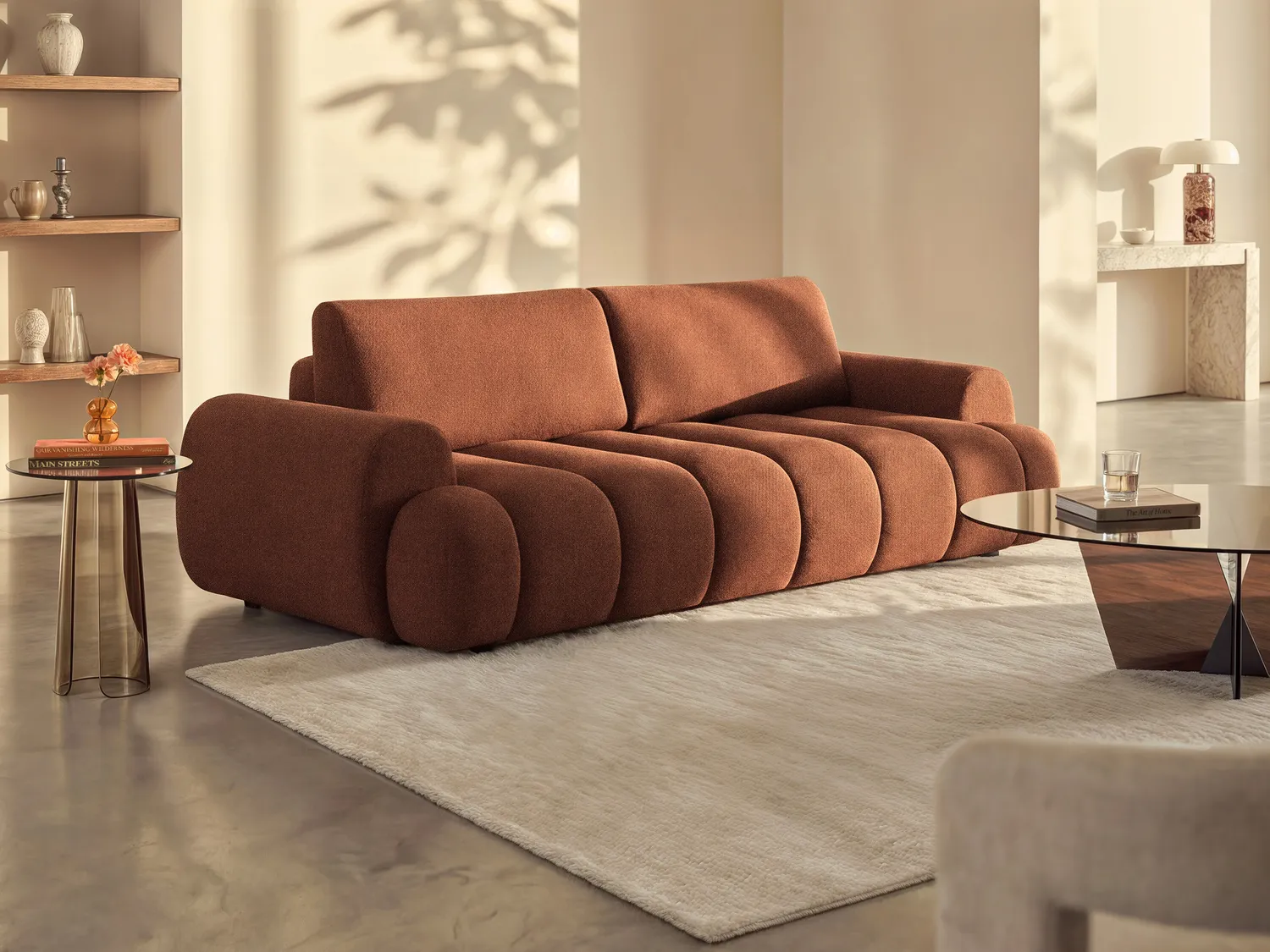
The relaxation area is the heart of the living room. It is generally arranged around a straight sofa, which is particularly well suited to narrow rooms thanks to its compact footprint. A standard model measures between 180 cm and 220 cm in length, allowing at least 70 cm of clearance for comfortable movement.
Pairing this sofa with a well-proportioned coffee table enhances the harmony of the overall look. To avoid overcrowding the space, opt for a coffee table approximately 100 cm long and 50 cm wide, with a height of between 35 and 45 cm.
Create an additional functional space
The other end of the living room can accommodate a secondary function, such as a reading nook or a work area. This visual separation can be achieved with a rug, specific lighting or a low piece of furniture.
Using a storage unit also helps structure the space while providing a practical solution for organising everyday items. A height of less than 120 cm is ideal for avoiding a visually heavy feel in the room.
Choose furniture suited to the proportions
Choosing the furniture is a key factor when arranging a long living room. Each piece should be selected according to its dimensions and visual impact.
Opt for clean lines
Furniture with simple lines helps make the space feel lighter. A wall-mounted TV unit or a shallow one, generally between 30 and 45 cm deep, frees up the floor and enhances the feeling of spaciousness.
Materials also play a key role. Light wood, glass or slender metal bring a sense of lightness, unlike bulky furniture, which accentuates the feeling of confinement.
Optimise storage
In a narrow living room, every centimetre counts. Storage solutions need to be both discreet and effective :
- Incorporate a storage sofa to hide away blankets, cushions or magazines
- Install shallow wall shelves (15 to 25 cm)
- Choose multifunctional furniture that combines storage with display space
- Make use of the ceiling height with vertical storage
The storage sofa is particularly well suited to this type of layout, as it combines comfortable seating with integrated storage space without making the room feel any more cluttered. |
Play around with the furniture layout
The arrangement of the furniture directly influences how the space is perceived. A well-thought-out layout can break up the monotony of a long, narrow living room.
Placing the sofa against a wall is not always the best option. Setting it slightly forward, around 10 to 20 cm from the wall, creates visual breathing space. In some cases, positioning the sofa perpendicular to the length of the room helps to structure the different areas naturally.
The TV unit should be positioned at a suitable distance from the sofa, generally between 2 m and 3 m depending on the screen size. This arrangement ensures optimum visual comfort while respecting the proportions of the room.
As for the coffee table, it should be centred in relation to the sofa, leaving at least 40 cm of clearance all around.
Work on perspective and depth
One of the main challenges of a long, narrow living room is correcting the narrow visual effect. Several techniques can make the space feel larger.
Use colours strategically
Light shades, such as off-white, beige or pearl grey, reflect light and make the room appear larger. Applying a slightly deeper colour to the back wall helps shorten the perspective and rebalance the proportions. Contrasts should be used sparingly to avoid fragmenting the space.
Bet on mirrors
Mirrors are an excellent tool for creating the illusion of depth. Placed on a side wall, they reflect the light and create a sense of openness.
A large mirror, for example 120 cm high by 60 cm wide, can radically transform the way the living room is perceived.
Get the lighting right
Lighting plays an essential role in designing a long, narrow living room. Well-distributed light helps to avoid dark areas and make the most of every space. Using multiple light sources is key:
- Install a central ceiling light for general lighting
- Add accent lamps to create a warm atmosphere
- Position wall lights to give the walls structure
- Use floor lamps to accentuate certain areas
The lighting should be even while highlighting the different functions of the living room.
Incorporate balanced decorative elements
Decor contributes to personalising the living room without compromising the harmony of the overall space. In a long, narrow room, every element must be chosen with care.
Rugs help define areas while adding comfort. A rectangular rug measuring 160 x 230 cm is perfectly suited to a standard living room area.
Curtains should be lightweight so they don’t make the room feel heavy. Linen or cotton sheers help diffuse natural light.
Wall Art should be distributed evenly. A horizontal composition allows you to follow the length of the wall without accentuating the corridor effect.
Facilitate smooth traffic flow
A good layout relies on smooth, intuitive movement. In a long, narrow living room, it is essential to keep passageways clear. A space of 70 to 90 cm should be allowed for the main routes through the room. Furniture should never obstruct these areas, as this could make the space uncomfortable. The arrangement should make it easy to move from one area to another, without visual or physical obstacles.
Every long, narrow living room is unique, as it reflects the habits of its occupants. The layout should therefore be designed around everyday use.
A household that regularly entertains will favour a spacious seating area with several seats. Conversely, a space dedicated to relaxation could include a comfortable armchair and a bookcase.
Storage needs also vary. A well-proportioned storage unit helps keep a space tidy without compromising on aesthetics. The key is to strike a balance between functionality and style, taking the room’s specific constraints into account.
